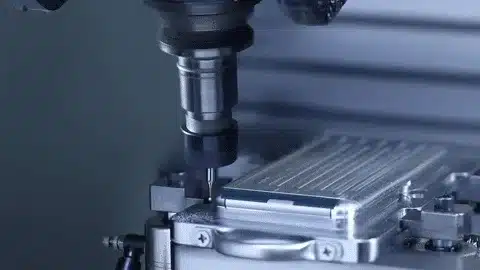
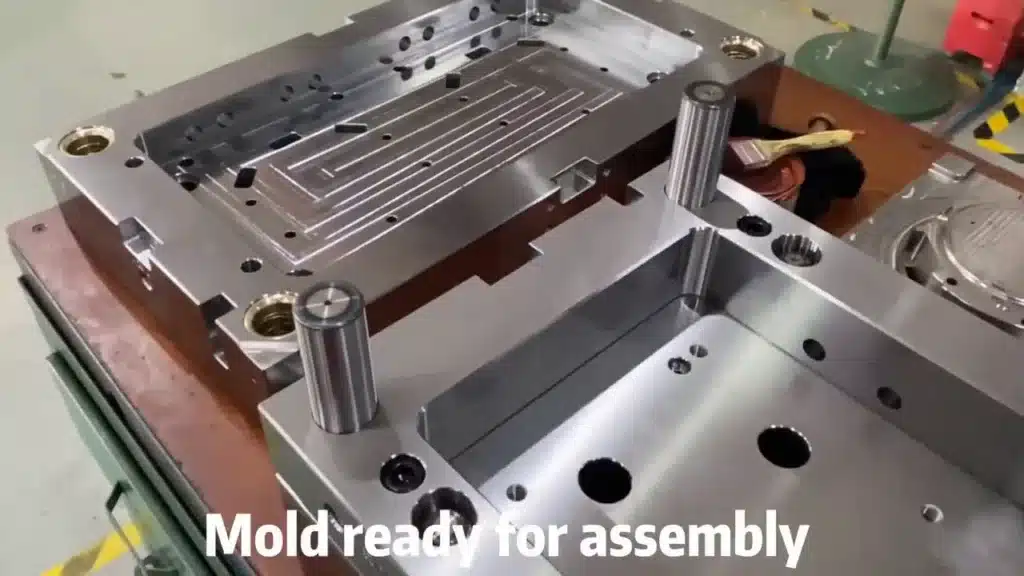
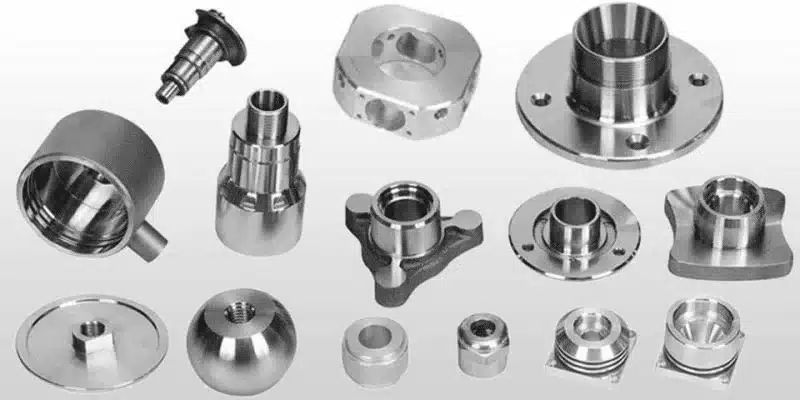
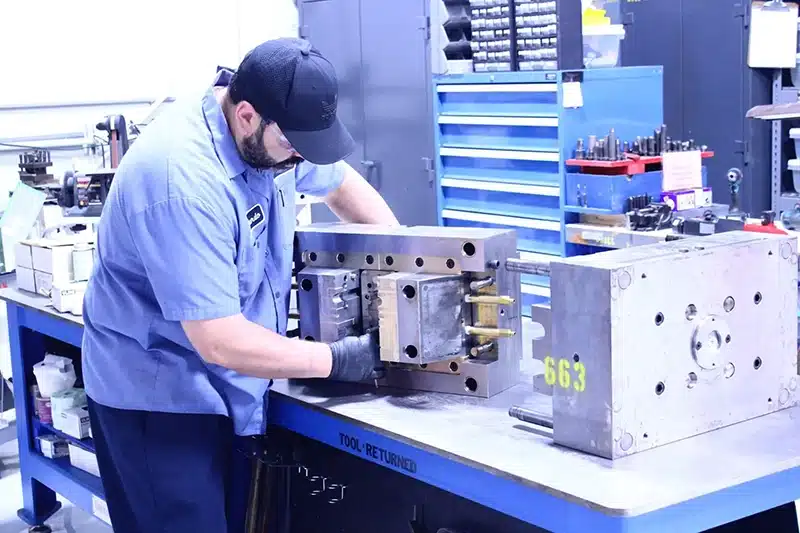
In a fine art of manufacturing such as in the molds, dies and tooling parts EDM machining and CNC machining do not actually compete; they address various challenges differently. CNC machining is one in which material is removed by mechanical means using rotating tools, electrical discharge machining (EDM) is one where material is removed using controlled electrical sparks in a dielectric fluid.The decision is narrowed to material characteristics, geometry of the part, requirement of tolerance and the toleration of cutting forces. Electrical discharge machining is also used in preference to CNC machining in cases where material is hard or has complex internal geometry or when accessing the tool with high-speed cutting would be inefficient or otherwise inconvenient.
EDM machining and CNC machining are complements of each-other processes. The choice of the appropriate one, or both, is based on the knowledge of their inherent strengths and weaknesses at the very beginning of the design process.
High-Level Comparison: EDM Machining vs CNC Machining
To a process planner, the key difference that can be made between the methods is the difference in the way each removes material and the constraint that it does.
The erosion lines caused by EDM are created through repeated electrical discharges and no physical contact between the tool and the material is made where CNC creates its erosion lines through mechanical shearing or by scraping a physical tool. This non-contact capability is what causes EDM to deal with situations where CNC fails whereas it is also what causes CNC to succeed in high volume or simple work.
The two processes are simultaneous since the modern shops continuously apply them in combination to maximize the cost, lead time, and quality. Here’s a clear side-by-side:
| Comparison Factor | EDM Machining | CNC Machining |
| Material removal | Electrical discharge erosion | Mechanical cutting |
| Tool contact | Non-contact | Direct tool contact |
| Material hardness limit | No practical limit (conductive only) | Limited by tool strength |
| Geometry access | Excellent for internal features | Limited by tool reach |
(For a visual breakdown of the EDM machining principle illustrated, see our detailed EDM machining principle illustrated diagram.)
When EDM Machining Is the Better Choice
When traditional tools used to cut would quickly wear out, deflect or just fail to cut the features that are required without losing accuracy or part integrity, EDM is the viable option to make such a cut.
This commonly occurs during molding and die-casting, and constituents begin as hard tool steels (HRC 50+). EDM slices these materials post heat treatment having no effect of any softening of the part or the distortion of the part due to cutting forces.
Key scenarios include:
- Machining hardened tool steel and carbide – When hardness is too great to be reliably machined on carbide end mills, tool life increases exponentially and tolerances drastically increase. EDM does not care about hardness provided that the material is able to conduct electricity.
- Making sharp internal corners and deep sunken features – Wire EDM can make almost zero-radius interior corners (typically within the range of 0.05 to 0.5 mm wire diameter, about a quarter of an inch), and sinker EDM is the best in making deep, narrow blind features, which long tools would chatter or break.
- Reducing cutting force and deformation – Thin walls, fragile inserts, or pre-hardened blanks The advantage of zero mechanical stress in EDM is an advantage to both thin walls, delicate inserts or pre-hardened blanks.
| Manufacturing Requirement | Preferred Process |
| Hardened materials | EDM machining |
| Blind cavities | EDM machining |
| Sharp internal corners | EDM machining |
| No cutting force allowed | EDM machining |
When CNC Machining Is More Efficient
CNC machining is an industry leader when rapidity, amount, or simple geometry is most significant.
In the case of softer or pre-machined materials, the bulk stock is removed at high feed rates and large tools using CNC. Open features, external contours, and generously radious parts optimally mill or are currently turned. Surface finishes may be excellently on the machine (RA 0.8-1.6 u with small passes and no further operations are sometimes required).
Practically, when the part is roughable and finishable at a reasonable cost using conventional and standard tools, and in cases where there is no danger of deflection or vibration, CNC tends to prevail in terms of cycle time and the cost per part.
Accuracy, Surface Finish, and Tolerance Considerations
The significant trade-offs are that both processes can be very high precision.
Very tight tolerances (e.g. ±0.005 mm or even less, to ±0.002 mm with multiple skims) particularly of hardened materials, due to lack of tool deflection or thermal expansion due to cutting forces. Surface finish is crater-like and matte but controllable fine finishing passes can progress to Ra 0.108 u, and mirror-like with mirror surfaces of the moulds.
CNC offers good accuracy (standard of 0.01mm, or 0.005mm or smaller with care), although it is not as efficient on hard material or deep tooling. The condition of the tools, speed and feeds are crucial to surface finish, normally as-machined raises Ra 1.63.2 ò, smaller finishes can be attained at a higher cost.
| Precision Aspect | EDM Machining | CNC Machining |
| Achievable tolerance | Very high (±0.002–0.005 mm) | High (±0.005–0.01 mm) |
| Surface finish | Controlled via discharge (Ra 0.1–0.8 µm possible) | Tool-dependent (Ra 0.8–3.2 µm typical) |
| Cycle time | Slower | Faster |
Tighter tolerances will always increase EDM cycle time as they require extra finishing strokes, thus only the tolerances that are required by functionality are given.
Using EDM and CNC Together in Real Manufacturing Projects
The most intelligent way to approach most of the mold and precision component projects is to have a two-way workflow: rough with CNC to remove most of the stock in a short period, followed by finishing the fine details with EDM.
This combination significantly reduces the total cycle time and cost any roughing on CNC may take hours instead of days on EDM alone and EDM is able to handle the detailed components without the risk of tool breakage or distortion of the parts. Designing the process early, preferably in the review of DFM, determines what features go to which process and has avoided the high cost of altering the project mid-way.
Common Misconceptions About EDM vs CNC Machining
The industry continues to have a number of myths that tend to result into inappropriate process decisions:
- CNC machining is replaced by EDM -No! EDM is less rapid and costly in large volumes removed; specifically a specialist device, not an overall substitute.
- EDM is more exact at small tolerances – on hard work EDM is within its abilities at small tolerances, whereas the CNC can do as well or better on soft material with open features.
- CNC is not capable of machining hardened materials – CNC is capable of machining hardened stock using ceramic or CBN tools, although the tool life is severely reduced, and costs have increased; EDM is usually still more cost-effective with HRC 55 or higher.
Conclusion — Choosing the Right Machining Process Starts with Requirements
Conclusively, EDM machining and CNC machining are not competitors but co-workers of precision machining. A decision must always go back to the functional requirements of the part material condition, geometric complexity, tolerances and surfaces requirements and volume of production. In pre-emptively addressing these factors, instead of defaulting to a single process, you reduce risk, contain costs and produce uniform quality.
In our practice in creating moulds, and making precision parts, on the one hand we find to run the most trouble-free, those in which the selection of the process occurs early and is dictated by the engineering requirements, and not by any a priori inclination.