The application of Sinker and Wire EDMs in machining processes is different and the appropriate process depends on the geometry of the part, tolerance needs and effects of application rather than accuracy per se. Although both are based on electrical discharge machining they are based on the fundamentally different geometry, tooling logic and manufacturing results of Sinker EDM and Wire EDM. Working in the field of precision tooling (more than thirty years) I have encountered teams wasting time and capital attempting to apply one approach when the other approach is obviously more suited to the task at hand. The distinction between sinker EDM and wire EDM lies in the fact that each cuts into material and what forms it can productively be able to make without excessive secondary work.
In Sinker EDM, a dielectric fluid, often oil, is used, and this takes the form of a custom made electrode (usually either graphite or copper) that is plunged into the workpiece where it erodes a mirror image cavity using controlled sparks. Wire EDM instead feeds a fine, continuously moving thin coated or pure wire of brass that is the electrode and cuts a programmed path through the material under deionized water. One develops volume effects such as deep pockets, the other does accurate profile cuts.
High-Level Comparison: Sinker EDM vs Wire EDM
Charitably, the general initial look will put them under the category of EDM as both occur by the use of a spark erosion mechanism rather than a mechanical cut, though the lineage does not go beyond that. Sinker EDM concerns itself with creating complex three-dimensional shapes whereas Wire EDM appears to create the precise 2D (or minor 2.5D) shapes.
The differences boiled down to the essentials are as follows:
| Comparison Factor | Sinker EDM | Wire EDM |
| Tooling method | Shaped electrode | Continuous moving wire |
| Machining approach | Cavity erosion | Profile cutting |
| Typical feature type | Blind cavities, complex pockets | Through cuts, contours |
| Programming logic | 3D cavity control | 2D/2.5D path control |
These foundations allow the prevention of unmet expectations at the very beginning of the quoting or designing stage.
To more effectively break down the visual representation of how the machines were designed and the effect of the dielectric flow to each process, check out this detailed EDM machine diagram.
How Sinker EDM Works and Where It Is Used
Sinker EDM is also bright when there is a necessity to manufacture blind features or complex internal geometries that are inaccessible on the side. The electrode is also carved (nowadays, it can also be 3D-printed) to the shape of the negative of the desired cavity, and lowered gradually, with sparks eroding the material. The part is not subjected to any mechanical force hence hardened tool steels remain distortion-free.
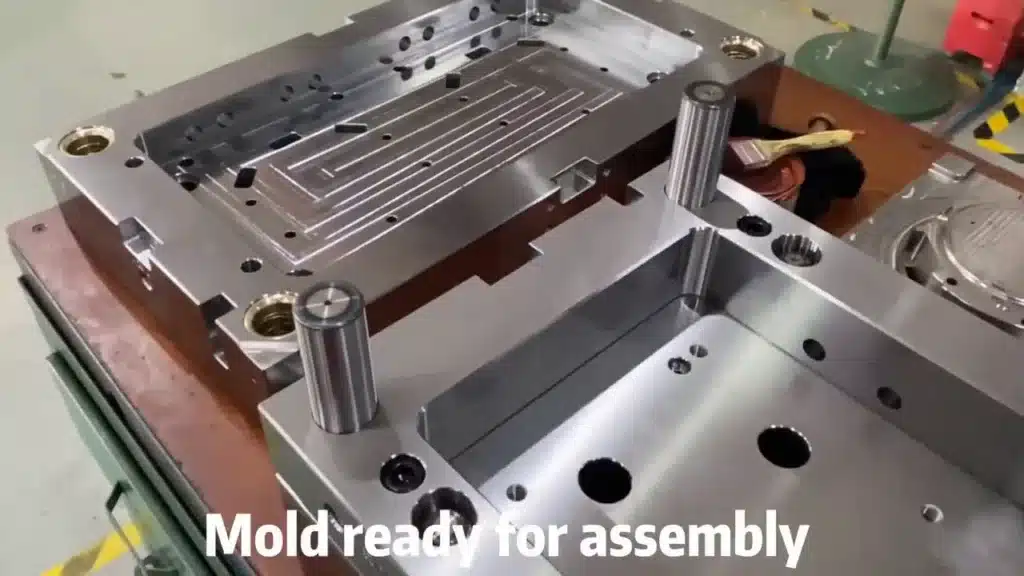
This either makes sinker EDM the choice of motion between mold core and cavity work. Consider deep ribs in injection tools, tooling textures or difficult undercuts. We have used it regularly in automotive and consumer electronics molds, in features where tool marks would be left by CNC milling, or which want tool angles that are impossible. It is not swift with large quantities, but in the case of high detail mold components, there is no other process that can compete the profundity and detail.
How Wire EDM Works and Where It Is Used
Wire EDM is a sawing machine that works like an electricity powered bandsaw. It is where a fine wire (usually 0.004 -0.12 inches) runs off between spools, it is always refreshed not to wear out and the workpiece moves in X/Y to repeat the outline. Several skim cuts are used to time-out the cut and cut-off as little as possible material each time to enhance finish and tighter tolerance.
This arrangement has high through-feature sharp external corners, and low kerf. Common examples are punches, progressive dies, extrusion dies and precision inserts. In tooling shops, blanking punches or carbide parts with positional precision and edge sharpness that cannot be compromised are common in wire EDM. It is slower per pass and can be trusted to run without requiring any human supervision on stacked plates.
Accuracy and Tolerance Comparison Between Sinker and Wire EDM
It is assumed that one is necessarily “more accurate, but this again is dependent on the type of feature and feature arrangement. Wire EDM is typically very linear in controlling profiles and sinker EDM is very consistent in deeper volumes.
Common ranges are such as this (assuming well-maintained machines, and multi-pass techniques):
| Accuracy Factor | Sinker EDM | Wire EDM |
| Typical tolerance | ±0.0005″ to ±0.001″ (moderate to high) | ±0.0001″ to ±0.0005″ (very high) |
| Surface finish | Ra 0.2–0.8 µm (depends on electrode and settings) | Ra 0.1–0.4 µm (very fine with skims) |
| Corner sharpness | Limited by electrode radius and wear | Extremely sharp internal corners |
Wire EDM well-finished surfaces may not require any secondary finish on surfaces that act as functional features, and sinker EDM may need light stoning or polishing in areas of visible moulds. Such issues as the quality of flushing, cooling power settings and material conductivity influence it more than the process itself.
Typical Applications and Geometry Suitability
Geometry prevails much more than pure accuracy specifications. When there is a requirement of 3D depth or the feature is blind, sinker EDM tends to win. Wire EDM is obviously the favorite of open profiles or thin sections.
Common examples:
| Application Type | Preferred EDM Method | Reason |
| Mold cavities | Sinker EDM | Blind features, complex 3D geometry |
| Punches and dies | Wire EDM | Precise through-cuts, sharp edges |
| Deep blind features | Sinker EDM | Volume removal without side access |
| Profile cutting | Wire EDM | Tight positional tolerance, minimal stress |
In actual moulds we usually fuse both: sinker to give the details of the cavities, wire to give the inserts or ejector plates.
Choosing Between Sinker EDM and Wire EDM in Real Projects
In the review of the design, at an early stage, when viewing the print of the part, ask: Does this feature cut all the way through? Can I access it from the side? What is the depth of the pocket in comparison with the width? High volume work High volume mold work tends to lean towards sinker cavity but stamping precisionfigure can do with the edge quality of wire.
Others are larger–both sinker and wire required–sinker to rough deep ribs, and wire to finish critical profiles. We had projects even postponed on an assumption made by the designer that the wire had the capability to accommodate a blind undercut; therefore, finding out at first save weeks. Volume, hardness of material, and down stream finishing are also involved do not overlook geometry though.
Common Misconceptions About Sinker EDM and Wire EDM
- Wire EDM has a higher level of accuracy, always, however, not the case with blind features or deep features; sinker can be a better positional repeat in cavities.
- Modern sinker machines can have orbital control, fine-finish settings SMART sinker machines are not utterly outdated. In lots of the applications of molds, modern sinker machines can compete with wire.
- The two kinds of EDM processes cannot be substituted, but rather complement each other. Mandatory replacement will tend to raise the expense or undermine quality.
Conclusion — Understanding EDM Process Differences Leads to Better Decisions
Sinker EDM and Wire EDM serve different purposes in the precision manufacturing. One fills the moulds with volumes of complexities; the other cuts the tools and dies with profiles accurate. A correct selection that is determined by the real geometry and tolerance requirements enhances lead times, minimizes rework, and produces parts that work as expected. The ideal process at the end is not the process that is better it is the one that suits the job.